Buy 4G Rotating Proxy with Real Mobile IPs — Cheap Plans
Technology June 27, 2026, Comments Off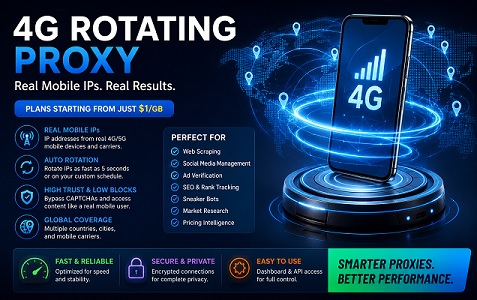
What Is a 4G Rotating Proxy and Why You Need One
More than 80% of all internet traffic now travels through mobile networks, yet most users still rely on outdated datacenter proxies that get blocked fast. The smarter solution is available on B12sites.com, where you can buy affordable 4G rotating proxy plans backed by real mobile device IPs starting from just $1 per GB. A 4G rotating proxy routes your traffic through genuine cellular-connected devices, cycling through fresh IP addresses automatically — making your activity indistinguishable from a real smartphone user on a carrier network.
Unlike datacenter IPs that websites recognize and flag almost instantly, mobile IPs carry a high trust score. They are shared among millions of real users on carrier networks, which means platforms, anti-bot systems, and data-protection layers treat your requests as legitimate organic traffic. This single distinction makes mobile proxies far more effective for automation, account management, and data collection than any server-hosted alternative.
The rotation mechanism is what gives these proxies their power. You can configure IP rotation from as short as five seconds to as long as several hours, depending on your task. Whether triggered by a timer, an API call, or a manual click, each new IP looks to the target server like a completely fresh mobile user reconnecting to a carrier tower — giving you near-unlimited operational flexibility.
How the IP Rotation Process Actually Works
Mobile IP rotation works the same way your smartphone does in real life. Every time a phone reconnects to a cellular tower after a dropout or an airplane mode toggle, the carrier assigns it a fresh IP address from a shared CGNAT pool. Proxy services replicate this exact behavior programmatically — reconnecting each device on demand to fetch a new, trusted carrier IP in under a second.
Services like OnlineProxy.io let you control rotation intervals through a clean dashboard or directly via API. You can set wanted rotation to change every two to five minutes for high-volume scraping, or use a Pattern-Break API call to trigger an immediate IP switch when you hit a rate limit or detection event. This on-demand control is what separates a great mobile proxy service from a basic one.
The result is a dynamic IP proxy that behaves exactly like a real mobile user pool — because it actually is one. Each address you receive comes from a real carrier like T-Mobile, AT&T, or Verizon, routed through a physical device with an active SIM. This natural process means your IPs pass trust checks that static residential or datacenter proxies simply cannot match.
Core Features That Define a Quality Rotating Proxy Service
The best rotating proxy service does far more than just change your IP address on a timer. A professional-grade platform on B12sites.com includes fast IP cycling, unlimited bandwidth options, cooldown mechanisms for fingerprint resets, and support for both HTTP/HTTPS and SOCKS5 protocols. These features combine to create sessions that look completely organic to even the most advanced bot-detection systems.
Reliability under load is equally important. Providers like OnlineProxy.io maintain performance even during high-concurrency operations, while platforms like Oxylabs carry ISO/IEC 27001:2022 certification — the gold standard for enterprise-grade security that businesses trust when handling sensitive tasks. For smaller operations, ProxyEmpire offers VPN and browser extension options with customizable server locations and rotation settings.
The ability to toggle rotation on or off is often overlooked but highly valuable. Some tasks — like managing a social media session or completing a checkout flow — require consistent IP persistence. Others, like SERP scraping or price monitoring, benefit from aggressive rotation. A service that lets you switch between sticky and rotating sessions from the same dashboard gives you operational control that single-mode proxies cannot.
Top Use Cases for 4G Rotating Mobile Proxies
Digital professionals across SEO, marketing, and development rely on 4G rotating proxies for a wide range of real-world tasks. Web scraping is the most common application — crawling e-commerce platforms, public business directories, search engine result pages, and competitor websites without triggering blocks or serving CAPTCHAs. Mobile IPs exit through real carrier networks, which means even well-protected targets rarely identify them as automated traffic.
Social media account management is another high-value use case. Running multiple accounts on Instagram, TikTok, Facebook, or Pinterest simultaneously requires genuine IP diversity. When each browser profile operates through a different mobile carrier IP, platforms cannot cross-link accounts through shared network fingerprints. Combined with anti-detect browsers like Multilogin or AdsPower, a 4G rotating proxy creates a session indistinguishable from a standalone physical device.
Additional use cases that benefit directly from mobile proxy rotation include:
- Ad verification — confirm how your ads appear to users in different carrier environments and locations
- SEO rank tracking — pull localized SERP results reflecting what real mobile users see
- Sneaker copping — run bots like Wrath AIO and Kodai AIO through trusted mobile IPs to avoid purchase blocks
- Competitor price monitoring — continuously scrape pricing data without hitting access restrictions
- Telegram and social media automation — run tools like Jarvee or Follow Liker with minimal ban risk
Comparing Leading 4G Rotating Proxy Providers
Choosing the right provider depends on your specific needs around pricing, rotation control, security, and scalability. Here is how the leading platforms compare across the most important dimensions:
| Provider | Starting Price | Rotation Control | Security Standard | Best For |
| OnlineProxy.io | $0.70/day, $1 trial | Dashboard + API | Operational security | Flexible, small-to-large scale |
| Oxylabs | Premium pricing | Advanced controls | ISO/IEC 27001:2022 | Enterprise and sensitive tasks |
| ProxyEmpire | Mid-range, flexible | VPN + browser ext | Data encryption | Custom location targeting |
OnlineProxy.io stands out for its accessible entry point — a 24-hour trial for just $1 makes it risk-free to test before committing. For businesses handling legally sensitive data or requiring audit-ready compliance, Oxylabs’ ISO-certified infrastructure justifies the premium. ProxyEmpire sits in the middle, offering geographic customization and flexible billing for agencies managing varied campaigns.
The right choice is always the one that matches your exact workflow. Before selecting a provider, confirm compatibility with your automation stack, verify that your target rotation intervals are supported, and read real user reviews on platforms like Trustpilot to separate marketing claims from actual performance.
How Businesses Use Rotating Proxies for Marketing and Research
Marketing teams managing multiple social accounts rely on rotating mobile proxies to keep each profile appearing as an independent, trusted user. Tools like Nextpost and Followadder automate posting and engagement — but platforms flag sessions sharing the same IP. A proxy rotation service assigns each session a fresh mobile IP, making every connection look like a unique user from a different device and location.
Data collection teams gain equally significant advantages. Mobile IP rotation allows collection of localized search results, competitor pricing, and platform-specific data that static proxies cannot access reliably. Since 4G IPs exit through real carrier networks, even secure e-commerce platforms and aggregator sites rarely block them. This means your research reflects what real customers actually see, not a filtered or blocked version of the page.
Market research at scale — pulling data across dozens of regions, devices, and carriers — becomes operationally straightforward with a proper rotating proxy network. The combination of geo-targeting at city level, carrier-specific IP selection, and configurable rotation intervals gives data teams the precision they need to build research pipelines that produce consistently accurate results without ongoing manual intervention.
Build Your Own 4G Proxy Farm: A Technical Overview
For advanced users who want complete control over their IP pool, building a self-hosted mobile proxy farm is a viable alternative to subscription services. The core hardware needed includes Android smartphones or 4G/5G USB modems (minimum three to five devices), a USB hub with per-port power switching, a Raspberry Pi 4 or low-power Linux server, and active SIM cards from different carriers. Running Ubuntu Server 22.04 LTS with 3proxy and ADB handles most of the software layer.
IP rotation on a self-built farm is handled by toggling airplane mode on each connected device through ADB scripts. When airplane mode turns off, the carrier reassigns a fresh IP to the device automatically. Scheduling this script via cron — for example, every 10 minutes — gives you continuous rotation without any manual intervention. Each device is assigned its own proxy port through the 3proxy config, so your scraper or automation tool can distribute requests across multiple carrier IPs simultaneously.
Scaling is straightforward: each new device added gets its own port assignment and interface entry in the config file. USB hubs supporting seven to ten ports handle small farm setups, while larger operations use rackmount hubs running fifty to one hundred simultaneous devices. Diversifying SIM cards across multiple carriers expands your IP pool and reduces the risk of a single carrier’s block affecting your entire operation — giving you the same breadth of coverage available through commercial services, built entirely on your own infrastructure.
Protecting Your Privacy with a Rotating Mobile Proxy Service
Every website visit and search query leaves a traceable digital footprint tied to your IP address. A rotating mobile proxy service interrupts this tracking loop by acting as an encrypted middleman — third-party sites and ad trackers never see your real IP, and your browsing activity becomes significantly harder to aggregate or profile. Services available on B12sites.com support this privacy layer through both time-based rotation and on-demand IP switching, ensuring no single address is held long enough to build a behavioral pattern.
Mobile IP rotation adds a structural privacy advantage beyond simple IP masking. Because each new address comes from a CGNAT pool shared by thousands of real carrier users, isolating your specific session from the broader pool is computationally impractical for most tracking systems. Combined with encrypted connections, this effectively anonymizes your activity without requiring a VPN or additional privacy layer on top.
Using a rotating proxy for privacy is entirely legal when applied to legitimate purposes — market research without exposing company infrastructure, safe collection of publicly available information, blocking third-party ad tracking, and protecting personal browsing from ISP-level logging. The key is choosing a provider with a clear data handling policy and transparent encryption standards, ensuring that the privacy protection extends not just to the sites you visit, but also to the proxy service itself.
Author
