Why Two Emeralds That Look the Same Can Cost Five Times More
Fashion & Lifestyle October 10, 2026, Comments Off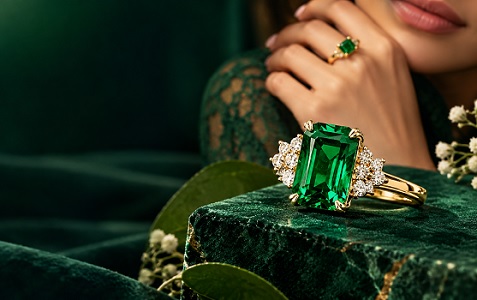
Put two one-carat emeralds side by side on a white tray and most people cannot tell them apart. Same green, same size, same sparkle under the store lights. One might cost $800 and the other $4,000, and both prices can be fair. Understanding why is a short lesson in how colored gemstones are valued, and in how much of that value is invisible to the person buying them.
Diamonds have a grading system that almost everyone has heard of. The four Cs, cut, color, clarity and carat, come with lab reports from the GIA and other institutes that put each stone on a scale. A buyer can compare two diamonds with the same report and expect similar prices. Colored stones have no equivalent. There is no universal grade for emerald color. Reports exist, but they describe the stone rather than rank it, and two gemologists can reasonably disagree about the same emerald. That leaves the price to be set by factors a buyer rarely sees.
Nearly every emerald has been treated
Emerald is a form of the mineral beryl, colored green by trace amounts of chromium or vanadium. It forms under geological conditions that leave it full of internal fractures and inclusions, which the trade calls the stone’s “jardin,” French for garden. An untreated emerald with high clarity is extremely rare and priced accordingly.
Because of that, the vast majority of emeralds sold anywhere in the world have been treated to improve their appearance. The traditional method is to fill surface-reaching fractures with cedar oil, which has a similar refractive index to beryl and makes the fractures far less visible. The more modern method uses resins or polymers, which are more permanent but also more controversial, since they can be harder to detect and harder to reverse.
Treatment is legal and accepted in the trade as long as it is disclosed. Grading labs classify the degree of enhancement on a scale that runs from none to minor to moderate to significant. The difference in price between a “minor” emerald and a “significant” one of the same size and color can be several times over. Both stones can look nearly identical in the case. Oil can also dry out or leak over years, which is why a stone that looked clean when it was bought can look worse a decade later.
Where it came from matters
Origin is the second large factor. Colombian emeralds from the Muzo and Chivor regions have historically commanded the highest prices for their saturated, slightly bluish green. Zambian emeralds, which entered the market in volume in the late twentieth century, tend to be a cooler green with better clarity and often sell for less per carat, though the gap has narrowed as buyers have become more familiar with them. Brazilian, Ethiopian and Afghan emeralds each carry their own reputations and price ranges.
Origin cannot be seen with the naked eye. A lab can often determine it by examining the stone’s inclusions and trace chemistry, but that service costs money and is usually only done for larger stones. For most of the emerald jewelry sold at retail, the origin on the tag is whatever the seller says it is.
Then there is color itself. Emerald value rises with saturation and falls as the stone moves toward yellow or blue or grey. The best stones have a vivid medium-dark green that holds up under different light. Lighter green beryl of the same mineral is often sold as “green beryl” at a fraction of the price, and the line between the two is a judgment call.
What this means for a buyer
The honest summary is that a person shopping for an emerald is in a worse position than a person shopping for a diamond, and the diamond shopper is already at a disadvantage. The stone’s treatment, origin and color grade are all known to the seller and mostly invisible to the buyer. A retailer that discloses them is doing something the trade does not require.
A few retailers have started going further and showing what the stone itself cost. TrueSanity, a jewelry company founded by a fourth-generation jeweler, publishes the cost of the metal, the stone, the labor and its own margin on every piece in its emerald rings collection. For a stone where so much of the value depends on information the buyer cannot verify, seeing the seller’s own number is one of the few ways to check whether a price makes sense.
Short of that, there are three questions worth asking before buying any emerald. Has the stone been treated, and with what? Where did it come from, and is that on paper? And what would the stone cost loose, without the setting? A seller who can answer all three clearly is more likely to be charging a fair price than one who cannot. The green in the case will look the same either way. The difference is in what the buyer knows.
Author
